

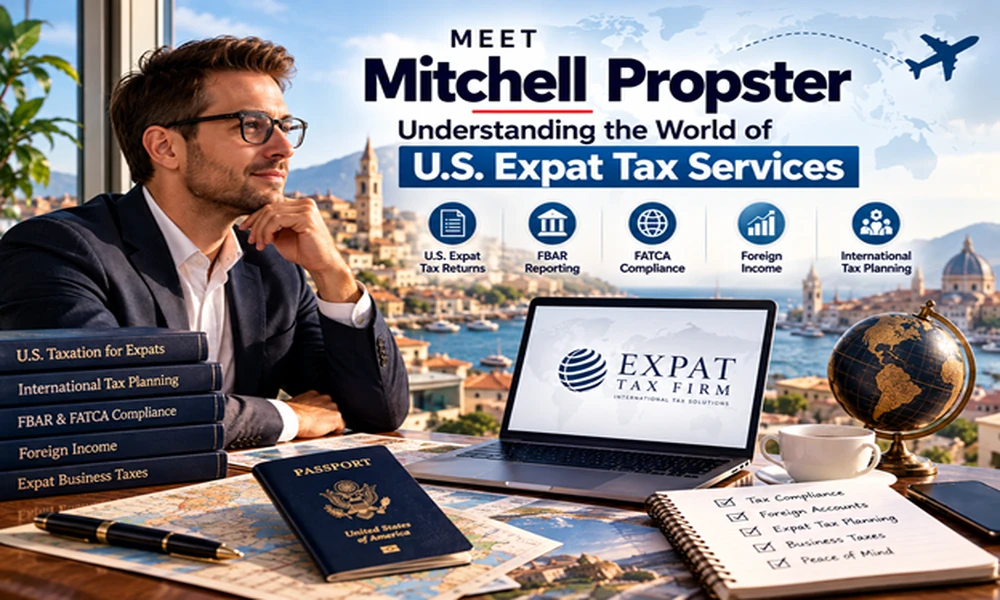
For Americans living outside the United States, tax responsibilities can become more complicated as personal finances extend across national borders. Employment income, foreign bank accounts, investments, business interests and retirement arrangements can all create U.S. tax and reporting considerations. Understanding these requirements is an important part of managing finances while living, working or operating a business overseas.
Mitchell Propster is identified by Expat Tax Firm as its founder and as a CTC and team leader. The firm focuses on tax and financial services for Americans living abroad, with services covering individual expat tax compliance, business taxation, foreign reporting and international tax planning.
The Role of Expat Tax Services
U.S. citizens generally remain subject to U.S. federal tax rules on their worldwide income even when they live in another country. This can create a situation where an American taxpayer needs to understand both U.S. requirements and the tax rules of their country of residence.
The issue is not limited to people who have recently moved overseas. Retirees receiving income from different countries, entrepreneurs operating foreign businesses, remote workers earning income while abroad and individuals maintaining overseas investments may all encounter international tax considerations.
This is the broader environment in which U.S. expat tax services operate. Rather than focusing exclusively on a standard domestic tax return, international tax work can involve examining income sources, residency, foreign accounts and additional information reporting requirements.
Mitchell Propster and Expat Tax Firm
Expat Tax Firm identifies Mitchell Propster as its founder and lists him among its tax specialists. The firm’s current team page describes Mitch as a CTC and team leader. The company states that its services are designed for expats, retirees, entrepreneurs and digital nomads dealing with U.S. and international tax requirements.
The firm’s service offering provides context for the type of international tax matters associated with its work. These include U.S. expat tax returns, expat business taxes, FBAR and foreign reporting, FATCA compliance, foreign income considerations and expat tax planning. It also offers assistance with overdue U.S. filings through the IRS Streamlined Filing Procedures.
More information about Mitchell Propster’s professional background can be found through his LinkedIn profile, while information about the firm’s international tax services is available through Expat Tax Firm.
U.S. Expat Tax Returns
Preparing a U.S. tax return from overseas can involve information that would not normally appear in a domestic taxpayer’s financial records. Foreign employment income, rental income, investments and other sources of income may need to be considered alongside U.S. reporting obligations.
Expat Tax Firm lists U.S. expat tax returns among its core services and describes its work as helping individuals understand and address U.S. tax compliance while abroad. The firm also provides services for expat-owned businesses, recognizing that business activity across borders can introduce additional tax considerations.
FBAR and FATCA Reporting
Foreign financial accounts are another important area of international tax compliance. Americans abroad may encounter FBAR reporting requirements when they hold qualifying foreign financial accounts above applicable thresholds.
FATCA can create additional reporting obligations for certain taxpayers with specified foreign financial assets. These requirements are distinct from the regular U.S. income tax return and can require taxpayers to provide additional information about their international financial interests.
Expat Tax Firm specifically lists FBAR filing and FATCA compliance among its services. Its international tax services also address foreign corporations, foreign partnerships, foreign trusts and other information reporting matters.
Foreign Income and International Tax Planning
Foreign income is another central issue for Americans abroad. A taxpayer may receive salary from a foreign employer, income from an overseas business, rental income from foreign property or investment income connected to international assets.
U.S. tax rules provide several mechanisms that may affect how foreign income is treated, including the Foreign Earned Income Exclusion and Foreign Tax Credit. The appropriate treatment depends on individual circumstances, including the taxpayer’s income, residence, foreign taxes and other financial factors.
International tax planning can therefore extend beyond preparing a return after the tax year has ended. Expat Tax Firm describes its tax planning service as a proactive approach that considers international tax residency, U.S. filing obligations, foreign income and financial planning. Its strategic tax review may also examine retirement and investment arrangements, including IRAs, 401(k)s, foreign pensions and Social Security.
Tax Considerations for Expats, Retirees and Business Owners
Different types of Americans abroad can face very different tax questions. An employee living overseas may primarily need to understand foreign employment income and available tax provisions. A retiree may have to consider pensions, investment income and retirement accounts in multiple jurisdictions. A business owner may face additional issues involving foreign companies, partnerships, reporting forms and business income.
These differences demonstrate why international tax planning is often highly dependent on individual circumstances. A solution that applies to one taxpayer may not apply to another simply because both live outside the United States.
Understanding the Broader Field
The work of Mitchell Propster and Expat Tax Firm sits within a broader field of international tax compliance that helps Americans navigate financial responsibilities across borders. The firm’s published services span individual tax returns, expat business taxes, foreign reporting, FBAR, FATCA, streamlined filing and international tax planning.
For Americans living overseas, understanding these areas can be an important first step toward managing their tax responsibilities. Whether someone is working remotely, running an international business, preparing for retirement or maintaining financial accounts abroad, the applicable U.S. requirements can depend heavily on their individual circumstances.
As international mobility continues to shape how people work, invest and retire, specialized knowledge of cross-border taxation remains relevant. Mitchell Propster’s role as founder and team leader at Expat Tax Firm places his professional work within this specialized area, while the firm’s published services illustrate the range of tax and reporting issues that Americans abroad may need to consider.