
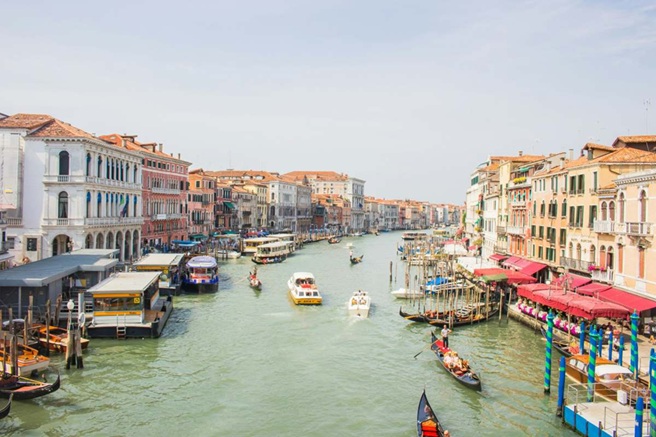
Venice doesn’t reward efficiency. If you arrive armed with maps, bookmarked must-sees, and a tight schedule, the city will quietly resist you. Bridges will appear where you didn’t expect them. Streets will narrow into passages that seem to end in walls. You’ll miss turns without realizing it. And this, inconvenient as it may feel at first, is precisely the point.
Venice is not a city to be consumed in order. It’s a city that reveals itself sideways.
When You Stop Navigating, the City Changes
The moment you stop trying to get somewhere specific, Venice starts behaving differently. The crowds thin out almost immediately. The soundscape shifts — fewer rolling suitcases, more footsteps, voices, water. You begin to notice the texture of the place: worn stone under your hand, laundry swaying between windows, the echo of a conversation disappearing around a corner.
This is Venice without commentary, and it’s far more convincing.
A City Built for Locals, Not Visitors
Venice is built for wandering because it was never designed for visitors. Its logic is local, historical, stubborn. Calli twist to avoid water, not to guide tourists. Campielli open suddenly, like pauses in a sentence. Even the absence of cars forces a different kind of attention.
You move at walking speed or not at all. Your body, not your phone, becomes the navigation system.
Losing Direction Changes Time
Getting lost also changes how you relate to time. Without a clear destination, minutes stretch. You stop checking the hour. You sit because a square feels right, not because it’s listed anywhere. You cross the same bridge twice without caring.
This is when Venice stops feeling like a museum and starts feeling like a place where life actually happens.
Away from the Performance
Another advantage of getting lost is that Venice becomes less performative. Away from the main arteries, the city drops its pose. Paint peels. Bells ring without announcement. Residents argue across windows.
The romance doesn’t disappear — it just becomes less obvious, more believable.
Eating Without a Plan
Even food tastes different when you’re not chasing recommendations. You eat where you happen to be, not where you planned to go. Menus are shorter. Portions feel honest. You learn quickly that good meals in Venice are rarely announced with signs.
They’re hinted at by who’s already sitting inside.
Everyday Venice, Unannounced
One of the quiet pleasures of wandering is stumbling into spaces that still belong to everyday Venetian life. A small grocery with no English labels. A carpenter’s workshop open onto the street. A bacaro where locals stop for a glass of wine without ceremony.
Understanding the role of calli, campielli, and historic bacari helps make sense of this daily rhythm. This travel story captures that hidden urban fabric without turning it into a lesson: https://www.vretreats.com/en/travel-stories/calli-campielli-historic-bacri-of-venice/.
Letting the City Be One Whole Place
There’s a subtle freedom in not recognizing where you are. Neighborhood names lose importance. You stop categorizing experiences. Venice becomes one continuous environment rather than a checklist of districts.
Staying overnight matters for this reason alone. Without pressure to “cover” anything, mornings unfold slowly and evenings settle naturally.
Finding Your Way Back, Changed
Eventually, you do find your way again. Venice is kind like that. But when you do, you’re not the same visitor who arrived. You’ve learned to trust detours, to walk without purpose, to let the city set the pace.
That’s when Venice stops being overwhelming — and starts being intimate.