

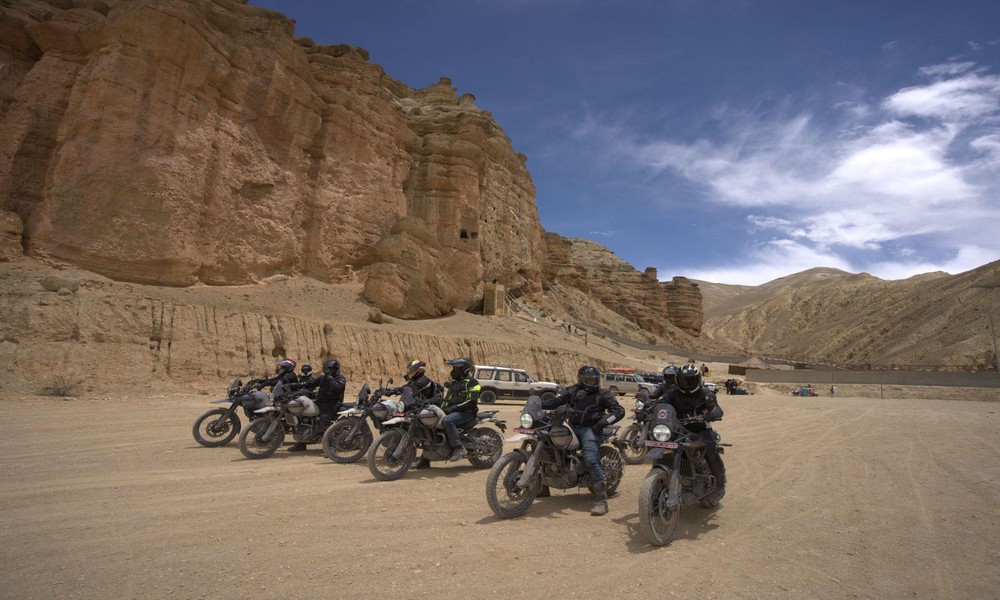
Someone will ask you, at some point before your first Himalayan motorcycle tour, which one you should do. Nepal or Ladakh. The question sounds simple. The honest answer is that they are so different in character that comparing them is a little like comparing open-water sailing to whitewater kayaking, both are water, both demand skill, both will test you but the experience of doing one tells you almost nothing useful about what doing the other will feel like.
This comparison is not written to declare a winner. It is written to give you enough honest, specific information about both destinations that you can identify which one is right for you, right now, at your current skill level, with your current budget, in your current season. Those four qualifiers matter more than almost anything else in this decision.
The Roads: Character, Not Just Condition
The most important thing to understand about Nepal’s mountain roads is that they are not uniformly bad. They are specifically bad in ways that require a particular skill set. River crossings, soft gravel that behaves like loose sand, sudden surface transitions from packed dirt to exposed rock, and road widths that shrink without warning to single-vehicle passages above sheer drops, these are Nepal’s defining road characteristics. The challenge is technical and requires constant active engagement. You cannot settle into a rhythm on Nepal’s mountain trails the way you can on a long Ladakhi straight. The road demands your full attention for most of the riding day.
Ladakh’s roads occupy a different register entirely. The Manali-Leh Highway, the Leh-Srinagar Highway, and the routes to Nubra Valley and Pangong Lake are, for significant stretches, actual roads paved, maintained by the Border Roads Organisation, and wide enough for two vehicles to pass without drama. What makes them challenging is not technical complexity but environmental scale.
The distances are vast. The altitude is extreme and sustained. The passes – Rohtang, Baralacha La, Lachung La, Tanglang La – arrive at you one after another over multiple days. The challenge of Ladakh is endurance, altitude management, and the psychological weight of sustained remoteness rather than the moment-to-moment technical demands that define Nepal.
This distinction matters enormously for rider self-assessment. A rider who is technically skilled on loose, variable surfaces but finds sustained high-altitude exposure difficult will find Nepal more manageable. A rider who is comfortable with altitude, confident on long days, but less experienced with technical off-road terrain will find Ladakh the more appropriate starting point.
Road Quality: The Honest Version
Neither destination should be described as having good roads in any conventional sense, but the qualification is important. Ladakh’s main arteries are maintained as strategic military routes, which means the Border Roads Organisation keeps them passable and repairs them with reasonable speed after damage. You will encounter sections of serious deterioration, particularly on the Manali-Leh approach and around the higher passes but you will rarely spend an entire day without encountering stretches of functional tarmac.
Nepal’s mountain routes, particularly anything north of the main Prithvi and Arniko Highways, operate without this infrastructure backstop. The Annapurna Circuit’s upper sections, the Mustang district roads, the tracks into Dolpo, these are maintained locally, intermittently, and with limited resources. A section that was rideable in October may be washed out by the following June and not repaired until September. Riders planning Nepal routes need current local intelligence about conditions in a way that Ladakh riders do not, because the variation between good and poor conditions is more extreme and less predictable.
Altitude: Duration and Profile
Both destinations involve serious altitude. The comparison between them is more nuanced than most summaries capture.
Ladakh’s altitude profile is sustained and high. Leh sits at 3,500 metres. The passes exceed 5,000 metres. Riders on the Manali-Leh Highway ascend from near sea level to over 5,000 metres in approximately two days of riding. The altitude gain is rapid, and most serious cases of altitude sickness on Himalayan motorcycle tours occur on this approach – riders pushing through Baralacha La and Tanglang La before their bodies have had adequate time to acclimatise.
Nepal’s altitude profile depends entirely on your chosen route. The Annapurna Circuit at its highest point – Thorong La at 5,416 metres – exceeds the height of every Ladakhi pass. But most Nepal riding routes do not sustain altitude in the way Ladakh does. You ascend to high passes, then descend into valleys that provide genuine recovery time at lower elevation. This valley-to-pass-to-valley rhythm is physiologically more forgiving than Ladakh’s sustained plateau altitude, where even your sleeping elevation remains above 3,500 metres throughout the journey.
The practical implication: riders with known altitude sensitivity – headaches above 3,500 metres, significant fatigue, sleep disruption – will likely find Nepal’s rhythmic altitude profile more manageable than Ladakh’s sustained high baseline. Riders without significant altitude history should treat both destinations with equal respect and plan conservative acclimatisation schedules for both.
Acclimatisation Strategy for Each
For Ladakh, the standard recommendation is to fly into Leh rather than ride the Manali approach, spend two full rest days at 3,500 metres before riding anywhere, and restrict initial riding days to lower elevation routes around the Indus Valley before attempting any pass crossing. This is not excessive caution – it is the approach that the majority of experienced Ladakhi riders and local guides consistently recommend, and the data on altitude sickness incidence on the Manali-Leh Highway supports it.
For Nepal, the acclimatisation strategy depends on your entry route. Flying into Kathmandu and riding immediately toward the Annapurna Circuit gives you several days of gradual ascent before reaching serious altitude. The bigger acclimatisation risk on Nepal’s routes is the temptation to push pass crossings that require pre-dawn starts at altitude – Thorong La is best crossed before 11 a.m. to avoid afternoon wind and weather, which means starting from High Camp at 4,800 metres in the dark, before the body has had time to fully adjust to the overnight elevation.
Permits and Bureaucracy: A Genuine Difference
This section matters more than most comparison articles acknowledge. The bureaucratic environment of the two destinations differs significantly and affects trip planning, cost, and flexibility in concrete ways.
Ladakh, as an Indian Union Territory, requires no special permit for Indian nationals riding its main routes. Foreign riders need an Inner Line Permit for certain restricted areas – Nubra Valley, Pangong Lake, the Dah-Hanu region – which is obtainable relatively straightforwardly through local agencies or online, typically within a day. The main administrative friction for foreign riders is ensuring the permit is current and covers the specific areas planned. The process is manageable and well-documented.
Nepal’s permit structure is more layered and more expensive, particularly for routes into protected areas and restricted regions. The Annapurna Conservation Area entry permit, the TIMS card, and the standard entry visa cover the main circuit. Motorcycle tour to upper Mustang requires a separate Restricted Area Permit that costs USD 50/day for the first ten days – a figure that immediately and substantially affects trip economics. Dolpo is similarly restricted and similarly expensive. Riders planning Nepal’s most compelling routes need to budget for permits as a significant line item, not an afterthought.
The positive framing of Nepal’s permit system is that the cost and restriction genuinely limits visitor numbers in protected areas, preserving riding conditions and cultural environments that unmanaged tourism would rapidly degrade. Upper Mustang’s extraordinary riding and remarkable Tibetan culture exist in the state they do partly because access is deliberately limited and priced. Whether this framing is consoling depends on your budget.
Cost Comparison: What Riders Actually Spend
Both destinations can be done cheaply or expensively. The comparison below reflects mid-range expedition costs for a solo rider on their own motorcycle over approximately two weeks, excluding international travel to the starting point.
Ladakh’s core costs like accommodation, food, fuel, and permits for standard routes – are broadly comparable to budget travel elsewhere in India, with the qualification that limited competition in remote areas means prices at high-altitude dhabas and guesthouses are higher than the Indian norm. A realistic daily budget for Ladakh, covering accommodation, meals, fuel, and incidentals but excluding major mechanical issues, is approximately USD 40-60 per day.
Nepal’s equivalent costs depend heavily on route choice. Riding the Annapurna Circuit without restricted area permits is broadly similar to Ladakh in daily expense. Adding the Upper Mustang permit immediately raises trip cost by USD 100 minimum. Food and accommodation costs in Nepal’s mountain areas are generally somewhat lower than Ladakh for equivalent quality. Fuel costs are comparable. The governing variable is which permits your route requires.
For riders operating on a defined budget, Ladakh offers more route flexibility for the money. Nepal’s most extraordinary routes carry premium permit costs that are non-negotiable.
Season: The Decision That Overrides Everything Else
This is the practical factor that most comparison articles treat as secondary and that experienced riders treat as primary. Both destinations have riding windows, and those windows do not fully overlap.
Ladakh’s primary riding season runs from mid-June to mid-September. The Manali-Leh Highway typically opens in late May or early June after snowmelt clears the high passes, and closes again in October when early snowfall makes the passes dangerous. Within the June-September window, conditions are broadly stable – cold at altitude, clear skies for the majority of days, with occasional afternoon thunderstorms that are dramatic but usually brief. This is a predictable and well-defined riding season.
Nepal’s riding season has two distinct windows separated by the Monsoon. The pre-Monsoon window runs from March to early June – excellent for the Annapurna Circuit, manageable for Mustang, variable for other high routes. The post-Monsoon window runs from October to November, offering the clearest skies of the year, freshly washed landscapes, and stable temperatures. The Monsoon itself – June through September – makes many of Nepal’s mountain routes genuinely dangerous, particularly anything involving river crossings that can rise fatally within hours of upstream rainfall.
The critical scheduling implication: the peak Ladakh season and the Nepal Monsoon overlap almost exactly. Riders choosing between destinations for a June-September trip are effectively choosing Ladakh by elimination, unless their Nepal route is specifically chosen for Monsoon suitability – which primarily means the rain shadow areas of Upper Mustang and Upper Dolpo, which receive dramatically less precipitation than the rest of Nepal during this period.
For riders with flexible timing, October or March in Nepal and June or September in Ladakh represent the sweetest spots in each destination’s calendar. Both offer ideal conditions and neither suffers from peak-season crowding to the degree that mid-July does.
The Riding Culture and People: An Underrated Comparison Factor
No gear list or route description captures what it feels like to move through the human landscape of each destination, and for many riders this dimension of the journey ultimately matters as much as the roads themselves.
Ladakh’s culture is Tibetan Buddhist in character, shaped by centuries of isolation and relatively recent integration with the wider Indian state. The monasteries of Hemis, Thiksey, Lamayuru, and Diskit are extraordinary – ancient, active, and accessible in ways that equivalent sites in Tibet are no longer. The Ladakhi people’s relationship with visitors is warm but increasingly shaped by heavy tourism in the Leh area and on the Pangong Lake route. The further from Leh you ride, the more the authentic character of Ladakhi culture reasserts itself.
Nepal’s cultural landscape along motorcycle routes is arguably more varied because the elevation range – and therefore the ethnic and cultural range – is greater. The Hindu-influenced culture of the lower hills transitions to Gurung and Magar communities on the Annapurna Circuit approaches, and to Tibetan-influenced Buddhist communities above 3,000 metres. Upper Mustang preserves a form of Tibetan culture that has largely disappeared from Tibet itself. Riding through this cultural gradient over the course of a single expedition is genuinely unlike any other motorcycle journey available anywhere.
The human dimension of Nepal riding also includes the Nepali motorcycle rider and guide community – experienced, resourceful, and hospitality-oriented in ways that make the tea house culture along Nepal’s routes one of the most consistently cited positive memories by riders who have done both destinations.
Which One Should You Do First?
After all the honest comparison, a direct recommendation is still possible.
If you are a relatively new adventure rider – fewer than three years of off-road experience, limited high-altitude exposure, working within a tighter budget – do Ladakh first. The roads are more forgiving of technical mistakes. The infrastructure, while minimal, is more consistent. The acclimatisation approach is better understood. The permit costs are lower. And doing Ladakh well builds the specific skills – altitude management, sustained remoteness, long mountain riding days – that Nepal then tests at a higher level of difficulty.
If you are an experienced adventure rider with solid technical skills, genuine altitude experience, flexibility in timing, and the budget for Nepal’s permit requirements – do Nepal first, or do it alongside Ladakh, because the riding it offers at its best is richer, more varied, and more demanding in the ways that experienced riders find rewarding rather than simply stressful.
If you ask most riders who have done both which they would choose if they could only ever do one again, the answer is Nepal. But the answer they give to which you should do first, if you are honest with them about your experience level, is almost always Ladakh.
Both answers can be true at the same time. That is what makes this comparison genuinely interesting rather than a simple ranking.